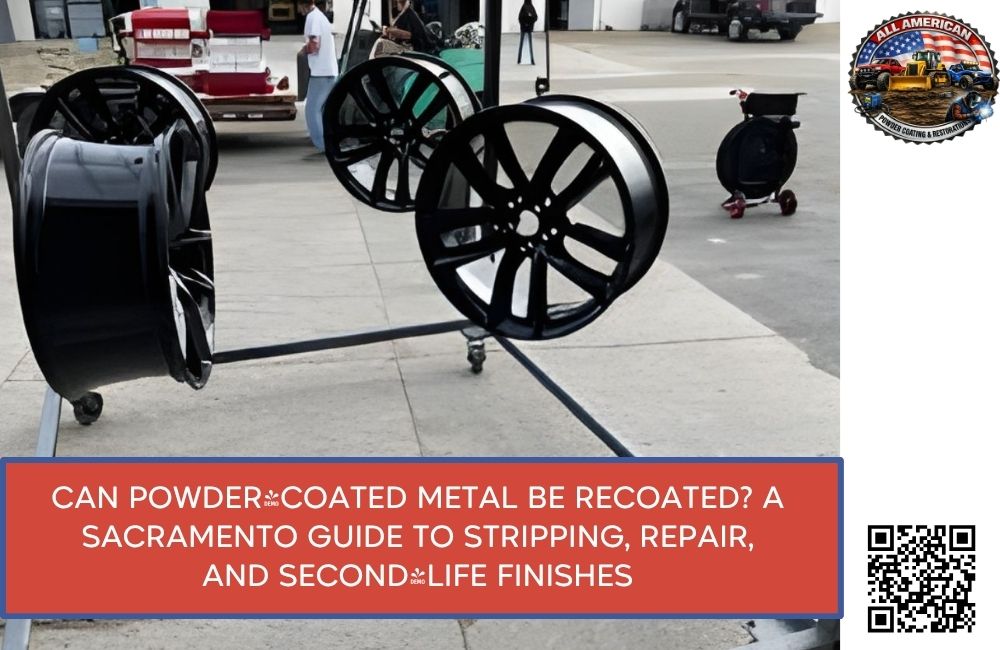
Can Powder-Coated Metal Be Recoated? A Sacramento Guide to Stripping, Repair, and Second-Life Finishes
Powder-coated metal does not always need to be replaced when the finish becomes faded, scratched, chipped, or outdated. In many cases, the part can be stripped, repaired, prepared again, and given a completely new finish.
For Sacramento homeowners, vehicle owners, builders, and businesses, recoating can be a practical way to extend the life of wheels, gates, furniture, brackets, automotive parts, commercial equipment, and other metal components. The key is understanding when the old finish can stay, when it needs to be removed, and what condition the metal is in underneath.
If you are searching for powder coating near me, this guide explains the most common questions about recoating and what to expect before starting a second-life finish.
Can Powder-Coated Metal Be Powder Coated Again?
Yes, many previously powder-coated metal parts can be recoated.
The old finish may need to be completely removed before the new coating is applied, especially when it is peeling, bubbling, cracked, corroded underneath, or incompatible with the new finish.
In some cases, a stable existing coating may be suitable for additional preparation and recoating, but that decision depends on the condition of the original surface.
A professional powder coating service should inspect the part before recommending whether the old coating should stay or be stripped.
When Does Old Powder Coating Need to Be Removed?
Complete stripping is usually the better choice when the existing finish has begun to fail.
Peeling, bubbling, widespread chipping, deep scratches, rust stains, or visible corrosion are all signs that the coating may no longer have reliable adhesion.
Recoating directly over an unstable finish can create a temporary cosmetic improvement while leaving the original failure underneath.
The new powder can only perform as well as the layer it is attached to.
For that reason, a qualified powder coating shop near me should evaluate the complete coating system, not just the visible color.
Can Powder Coating Be Applied Over Existing Powder Coating?
Sometimes, but it is not always recommended.
If the original powder is fully bonded, clean, undamaged, and compatible with the new material, the surface may be mechanically prepared before an additional coat is applied.
However, there are several risks.
The existing finish may contain invisible contamination, adhesion weakness, UV damage, or corrosion around edges and seams. Adding another coating layer can also increase thickness and affect threads, hinges, mounting surfaces, or tight-fitting parts.
For high-value, automotive, or heavily used components, complete stripping often provides a more predictable foundation.
How Is Old Powder Coating Removed?
Previously coated metal can be stripped using several methods depending on the part, metal type, coating thickness, and condition.
Professional shops may use chemical stripping, media blasting, mechanical preparation, or a combination of methods.
The goal is to remove the failed finish without damaging the underlying metal.
Steel parts may tolerate more aggressive preparation than thin aluminum or detailed decorative pieces. Wheels, motorcycle parts, and precision components often need a more controlled approach.
Why Stripping Is Important Before Recoating
Stripping does more than remove color.
It allows the shop to see what is happening underneath the finish.
Once the old powder is gone, the technician may discover corrosion, cracks, damaged welds, pitting, bent sections, oil contamination, or previous repairs.
This is especially important for older parts where the coating has been in place for years.
What looks like a simple color-change project may actually require metal restoration services before recoating can begin.
Can Rusty Powder-Coated Metal Be Recoated?
Yes, but the rust must be addressed first.
Powder coating should not be applied over active corrosion.
If rust has developed under the old coating, it should be removed through blasting, grinding, cleaning, or another suitable restoration process.
Deep corrosion may also require welding, reinforcement, or replacement sections.
A new finish will not stop structural deterioration if the metal underneath is already badly weakened.
For Sacramento customers, this is especially relevant to gates, railings, trailers, outdoor furniture, automotive parts, and commercial equipment exposed to moisture or irrigation.
What Repairs Should Be Done Before Recoating?
All repair work should be completed before the final finish is applied.
That includes welding, grinding, drilling, straightening, reinforcement, bracket replacement, and custom fabrication.
Powder coating should be one of the final stages of the project.
If welding is completed afterward, the heat can burn and discolor the coating and expose bare metal.
A proper recoating project should treat the part as a complete restoration rather than simply a color change.
Can Wheels Be Powder Coated More Than Once?
Yes, structurally sound wheels can often be powder coated again.
Professional Wheel powder coating may be appropriate when the original finish has faded, chipped, corroded, or no longer matches the vehicle.
The old coating should be removed so the wheel can be inspected properly.
This is important because the stripping process may reveal cracks, bends, pitting, damaged lug holes, or previous repairs.
A new finish cannot make a structurally unsafe wheel safe.
What About Rims Powder Coating?
Rims powder coating can also be repeated when the wheels remain suitable for refinishing.
A second-life finish may be used to change from gloss black to bronze, satin to metallic, factory silver to a custom shade, or simply to restore a damaged original appearance.
The most important step is not the new color. It is making sure the old coating and corrosion are removed and the rim is prepared correctly.
Can Automotive Powder-Coated Parts Be Refinished?
Yes. Many automotive powder coating projects involve parts that have been coated before.
Common examples include suspension parts, valve covers, brake calipers, brackets, motorcycle parts, off-road components, and frame pieces.
Used automotive parts often require more cleaning than new metal because they may contain oil, grease, brake fluid, road grime, silicone, or embedded contamination.
Heat during curing can draw those contaminants to the surface and cause bubbling or pinholes.
That is why degreasing and pre-baking may be needed before the second finish is applied.
Does Recoating Change the Thickness of the Part?
Yes, powder coating adds measurable thickness.
If the old coating is fully stripped, the new finish generally replaces the previous coating thickness.
If another layer is applied over an existing finish, the total thickness increases.
That can affect:
Threads, bearing seats, hinge areas, press-fit components, mounting surfaces, electrical grounds, and tight-clearance assemblies.
These areas may need careful masking before recoating.
Can Outdoor Powder-Coated Metal Be Refinished?
Yes. Gates, railings, patio furniture, fencing, handrails, and decorative metal can often be restored and recoated.
Outdoor finishes usually fail because of a combination of UV exposure, moisture, scratches, and corrosion.
The new powder should be selected for exterior performance.
Using a coating designed for indoor use may lead to faster fading or chalking under Sacramento sun.
The shop should consider UV stability, moisture resistance, color retention, and the location of the part before recommending a finish.
How Do You Know if Recoating Is Better Than Replacement?
Recoating often makes sense when the metal is structurally sound, expensive to replace, custom-made, difficult to source, or part of a matching set.
Examples include classic automotive parts, custom wheels, wrought iron gates, patio furniture, equipment brackets, and fabricated commercial components.
Replacement may make more sense when corrosion has caused major metal loss, cracks are extensive, the part is distorted, or repair costs exceed the value of the component.
The best decision depends on the condition of the base metal, not the appearance of the old finish.
Can Commercial Equipment Be Recoated?
Yes. Commercial powder coating is often used to refresh equipment frames, brackets, guards, carts, enclosures, racks, trailer parts, and fabricated assemblies.
Businesses may choose recoating when the equipment still functions well but the finish has deteriorated.
Recoating can improve appearance, reduce exposed corrosion, and help standardize finishes across multiple components.
For repeat commercial work, documenting the powder manufacturer, color code, gloss level, and masking requirements can make future batches easier to match.
Is Recoating Cheaper Than Starting With New Metal?
Sometimes.
The cost depends on how much stripping, blasting, repair, cleaning, and masking is required.
A lightly worn part with a stable underlying structure may be relatively straightforward to restore.
A heavily rusted or contaminated part may require significant labor before recoating can begin.
That is why customers comparing powder coating Sacramento providers should ask for an estimate based on the complete restoration process rather than only the coating step.
Can You Change Colors When Recoating?
Yes. Recoating is an opportunity to completely change the appearance of the part.
Common options include gloss, satin, matte, metallic, textured, bronze, black, silver, bright custom colors, and multi-stage finishes.
Some specialty colors may require a base coat or clear topcoat.
The shop should also explain how the new finish will perform under sunlight, heat, moisture, chemicals, and repeated cleaning.
How Long Does Recoated Powder Coating Last?
A properly stripped, repaired, prepared, and recoated surface can last for years.
Its lifespan depends on the same factors as a first-time coating job.
Surface preparation, coating chemistry, curing, environment, abrasion, UV exposure, cleaning products, and impact all influence durability.
A second-life finish should not be treated as inferior simply because the part was previously coated.
When the old coating is properly removed and the substrate is restored, the new finish can perform like a completely new coating system.
Does Recoating Fix Previous Coating Defects?
It can, but only if the cause of the defect is addressed.
If the original coating failed because of poor cleaning, contamination, rust, incorrect curing, or bad surface preparation, simply applying more powder will not solve the problem.
The part needs to be stripped back and the underlying issue corrected.
That may require degreasing, blasting, outgassing, welding repair, or different masking and curing procedures.
Frequently Asked Questions About Recoating Powder-Coated Metal
Can you powder coat the same part twice?
Yes. Many parts can be stripped and powder coated again if the metal remains suitable for refinishing.
Do you have to sandblast old powder coating off?
Often, yes, although chemical stripping or other methods may also be used depending on the part and coating.
Can chipped powder coating be repaired?
Small areas may be touched up, but widespread damage often produces better results when the part is fully stripped and recoated.
Can old powder-coated wheels be refinished?
Yes, provided the wheels are structurally sound and properly inspected after the old coating is removed.
Can powder coating hide rust pits?
It can cover minor surface texture, but deeper pitting may remain visible unless additional restoration work is completed.
Where can powder-coated metal be recoated near Sacramento?
All American Powder Coating & Restoration in West Sacramento provides stripping, blasting, restoration, welding, fabrication, and recoating services for automotive, residential, and commercial metal projects.
Give Good Metal a Second Finish Instead of a First Replacement
A worn powder-coated finish does not automatically mean the metal underneath has reached the end of its life.
In many cases, stripping the old coating, repairing damage, cleaning the surface, and applying a new finish can extend the usefulness of wheels, gates, furniture, automotive parts, and commercial components.
The most important step is evaluating the metal before choosing the finish.
For anyone comparing powder coating near me options in Sacramento, ask whether the shop can handle the full process from stripping and restoration through final coating. A second-life finish works best when the project begins with sound metal and proper preparation.
All American Powder Coating & Restoration
3959 Commerce Dr, West Sacramento, CA 95691, United States
Phone: +1 (916) 373-9949
