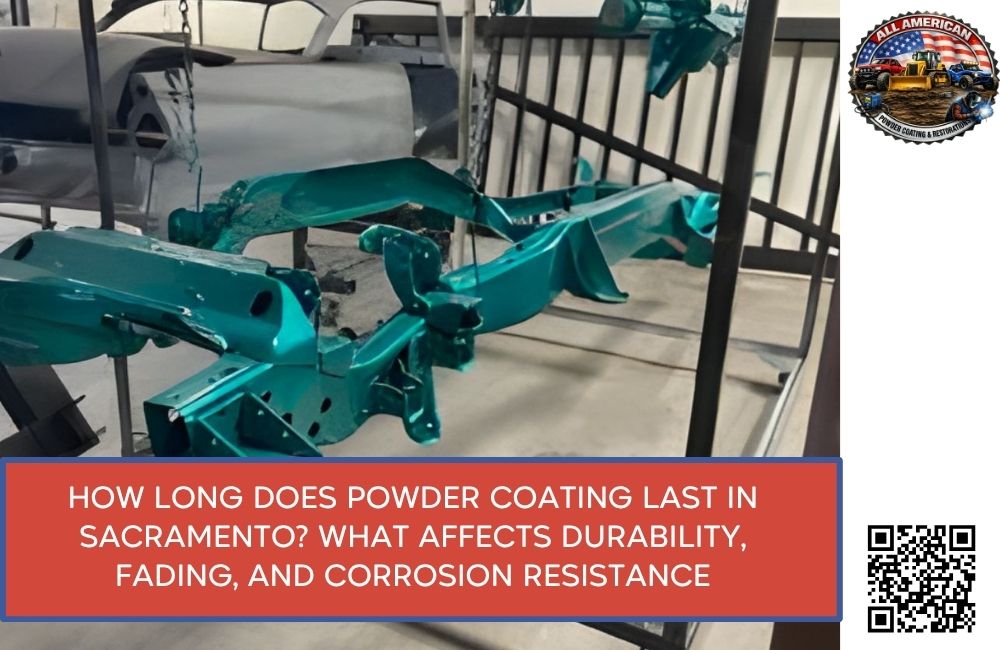
How Long Does Powder Coating Last in Sacramento? What Affects Durability, Fading, and Corrosion Resistance
One of the most common questions people ask before refinishing metal is simple: how long does powder coating actually last?
There is no single lifespan that applies to every project. A properly prepared and professionally applied powder coating can remain attractive and protective for many years, but its real-world durability depends on the metal, coating chemistry, surface preparation, UV exposure, moisture, heat, chemicals, abrasion, and maintenance.
In Sacramento, those variables matter. Metal parts may spend years under intense summer sun, on vehicles exposed to road debris, beside irrigation systems, or outdoors through wet winters. Understanding what affects coating life can help homeowners, vehicle owners, fabricators, and businesses make better finishing decisions instead of judging a project by color alone.
How Long Does Powder Coating Typically Last?
For many residential, automotive, and commercial applications, a professionally applied powder-coated finish can last for years before significant fading, peeling, or corrosion becomes noticeable.
That does not mean every coating performs the same way. An indoor metal table experiences very different conditions than a set of truck wheels, an outdoor gate, or an industrial bracket.
A high-quality powder coating service should consider how the part will actually be used before recommending the finish. The expected life of the coating depends far more on that match than on the general term “powder coating.”
What Has the Biggest Effect on Powder Coating Durability?
Surface preparation is one of the most important factors.
Powder adheres best to clean, stable, properly prepared metal. If rust, oil, old paint, oxidation, silicone, or moisture remains beneath the finish, the coating may look good initially but fail earlier than expected.
Preparation may include stripping, sandblasting, media blasting, degreasing, rust removal, pre-baking, and masking.
This is why people comparing a powder coating shop near me should ask what happens before the powder is applied, not only what colors are available.
A durable coating begins with the condition of the metal underneath.
Does Sacramento Heat Shorten Powder Coating Life?
Sacramento summers can expose outdoor metal to prolonged heat and direct sunlight.
Heat alone does not automatically ruin powder coating, but the wrong coating formulation may lose gloss, fade, chalk, or change color faster when exposed to strong UV radiation.
Exterior applications should use powder designed for outdoor exposure and UV stability.
This matters especially for gates, railings, patio furniture, architectural metal, commercial fixtures, and other pieces that remain outside year-round.
An indoor-grade finish may perform well inside a building but deteriorate much faster when used outdoors.
Does Powder Coating Fade in the Sun?
Yes, powder coating can fade, but the rate depends heavily on the coating chemistry and exposure.
Some powder formulations are better suited for UV exposure than others. Exterior-grade polyester powders are commonly selected for outdoor applications because of their weatherability and color retention.
Dark colors, bright custom shades, metallic finishes, and certain specialty colors may age differently.
A reliable shop should explain whether the chosen finish is appropriate for constant sun exposure rather than assuming every powder performs the same way.
For customers researching powder coating Sacramento, UV stability should be part of the discussion whenever the finished metal will live outdoors.
How Does Moisture Affect Powder-Coated Metal?
Moisture is one of the biggest threats to exposed steel.
When the coating remains intact, it acts as a barrier between the metal and the environment. Problems usually begin when deep scratches, chips, failed adhesion, or poorly prepared rust allow moisture to reach the substrate.
In Sacramento-area properties, sprinkler overspray can be especially hard on gates, fences, railings, and outdoor furniture because the metal may stay wet repeatedly.
Powder coating does not make metal permanently immune to corrosion. Instead, it helps reduce exposure when the surface is properly prepared and the coating remains intact.
Can Rust Form Under Powder Coating?
Yes, especially if corrosion was not removed before finishing or if the coating becomes deeply damaged.
Powder should never be treated as a way to hide active rust. If rust remains beneath the surface, it can continue spreading and eventually cause bubbling, peeling, or lifting.
Professional metal restoration services may be needed before coating older parts with visible corrosion, pitting, failed welds, or previous repair work.
This is particularly important for older gates, trailer parts, classic automotive components, equipment frames, and outdoor furniture.
How Long Does Automotive Powder Coating Last?
Professional automotive powder coating can last for years when the part is properly prepared and the coating is suited to its operating environment.
However, automotive parts experience demanding conditions.
Wheels are exposed to brake dust, road debris, cleaning chemicals, water, and curb contact. Suspension parts face gravel, mud, vibration, and impacts. Engine-bay components may experience heat, oil, and chemical exposure.
These conditions mean automotive coatings often show wear sooner than decorative indoor parts.
That does not necessarily indicate poor quality. A wheel on a daily-driven truck simply faces a much tougher environment than a powder-coated table indoors.
How Long Does Wheel Powder Coating Last?
Professional Wheel powder coating can provide durable protection and appearance for many years, but wheel use varies significantly.
A commuter car driven mostly on paved roads may retain its finish longer than an off-road truck, work vehicle, or car frequently exposed to harsh wheel cleaners.
Regular washing can help reduce brake dust buildup and chemical residue.
Deep curb rash, rock impacts, and aggressive cleaning products can eventually damage even a strong coating.
For structurally sound wheels, powder coating can still offer strong long-term value compared with repeatedly repainting worn finishes.
Does Rims Powder Coating Chip Easily?
Properly applied Rims powder coating is generally resistant to normal wear, but it is not impact-proof.
A large rock strike, curb impact, tire-mounting damage, or metal-on-metal contact can chip the surface.
The important difference is how well the surrounding coating remains bonded after localized damage.
Good preparation helps prevent a small chip from turning into widespread peeling.
If bare metal is exposed, addressing the damage early can reduce the chance of corrosion spreading underneath the finish.
Does Color Affect Powder Coating Lifespan?
Color itself is only one part of the equation.
The powder chemistry, gloss level, UV resistance, and coating system matter more.
Gloss finishes can be easier to clean, while matte or textured finishes may hide scratches or surface variation better. Metallic and specialty finishes may require specific application techniques or clear topcoats.
When choosing a custom color, ask how that powder performs under the expected environment rather than choosing only by appearance.
How Do Cleaning Products Affect Powder Coating?
Cleaning habits can significantly influence finish life.
Mild soap, water, microfiber cloths, and non-abrasive brushes are generally safer for powder-coated surfaces.
Aggressive acids, strong solvents, abrasive pads, harsh wheel cleaners, and certain industrial chemicals may dull, soften, stain, or damage the finish.
Outdoor metal should also be rinsed periodically if it is exposed to irrigation residue, dust, road grime, or chemical contamination.
Good maintenance does not require complicated products. Consistent gentle cleaning is usually more useful than aggressive restoration cleaning.
Can Powder-Coated Metal Be Repaired?
Small areas of damage may sometimes be touched up, but field repairs usually do not look or perform exactly like the original oven-cured finish.
If the coating has widespread peeling, deep corrosion, extensive fading, or multiple damaged areas, stripping and recoating may produce a better result.
A professional shop can evaluate whether repair or full refinishing is more practical.
This is one reason customers searching for powder coating near me should choose a provider that also understands stripping, blasting, and restoration rather than only application.
When Should Powder-Coated Metal Be Refinished?
There is no universal schedule.
Refinishing should be based on condition rather than age alone.
A coating may need attention when it develops widespread fading, peeling, bubbling, deep chips, corrosion, or loss of adhesion.
Outdoor metal should be inspected periodically, especially around welds, edges, fasteners, hinges, and high-contact areas.
Automotive parts should also be checked after impacts or exposure to harsh chemicals.
Addressing isolated damage early is often easier than waiting until corrosion spreads.
Does Commercial Powder Coating Last Longer?
Commercial powder coating can be very durable, but commercial use is often harder on the finish.
Equipment frames, machine guards, racks, brackets, trailers, and fabricated components may face repeated handling, impacts, chemicals, vibration, and outdoor storage.
For those applications, the best coating system should be selected based on the operating environment rather than appearance alone.
Commercial customers should also consider repeatability, masking, coating thickness, and batch consistency.
A finish that performs well on decorative furniture may not be the best choice for industrial equipment.
How Can You Get the Longest Life From Powder Coating?
The most effective approach is simple: start with sound metal, use proper preparation, select the correct powder, cure it properly, and maintain the finish sensibly.
Customers comparing a powder coating shop near me should ask how the shop handles rust, cleaning, blasting, masking, coating selection, and curing.
Those details usually tell you more about expected durability than the brand name or color chart.
Frequently Asked Questions About Powder Coating Durability
Does powder coating last longer than paint?
For many suitable metal applications, powder coating can provide stronger adhesion, more consistent coverage, and better chip resistance than basic liquid paint. The result still depends on preparation and operating conditions.
Can powder coating withstand Sacramento summers?
Yes, when the powder is designed for exterior UV and heat exposure. Outdoor-grade formulations are important for long-term color and gloss retention.
Does powder coating prevent all rust?
No. It helps protect metal from moisture, but corrosion can develop if rust remains underneath or if the finish is deeply damaged.
How often should powder-coated wheels be cleaned?
Routine cleaning is better than waiting for heavy brake dust buildup. Use mild, non-abrasive products that are safe for powder-coated finishes.
Is it worth recoating old metal?
Often, yes, if the underlying metal remains structurally sound. Restoration can be especially worthwhile for custom parts, wheels, furniture, gates, commercial components, and hard-to-replace metalwork.
Durability Starts Before the Powder Is Applied
The lifespan of powder coating is determined by the entire finishing process, not just the final layer.
Proper rust removal, surface preparation, cleaning, coating selection, curing, and maintenance all influence how well the finish resists fading, corrosion, and everyday wear.
For Sacramento-area homeowners, drivers, builders, and businesses, the most useful question is not simply “How long does powder coating last?” It is “Was the metal prepared and coated correctly for how I plan to use it?”
That is what ultimately determines whether a finish lasts a few seasons or remains dependable for years.
All American Powder Coating & Restoration
3959 Commerce Dr, West Sacramento, CA 95691, United States
Phone: +1 (916) 373-9949
