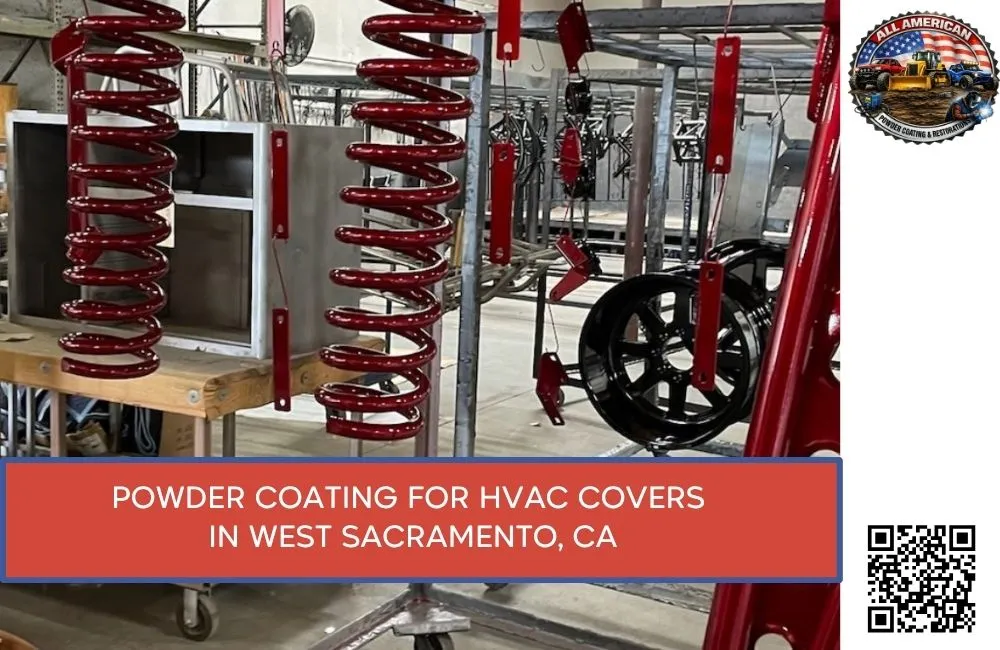
Powder Coating for HVAC Covers in West Sacramento, CA
Outdoor heating and cooling equipment works hard throughout the year, especially in West Sacramento, where summer temperatures regularly place significant demands on air conditioning systems. While homeowners and business owners focus on keeping their HVAC equipment running efficiently, the metal covers, protective panels, and surrounding enclosures often receive less attention.
Over time, these components can develop scratches, faded paint, surface corrosion, and other signs of wear. Exposure to sunlight, seasonal rain, irrigation water, and airborne dust can gradually affect their appearance and protective finishes.
For suitable removable metal components, powder coating offers a way to restore appearance and improve resistance to environmental exposure. However, HVAC equipment requires special consideration because airflow, heat transfer, electrical safety, and manufacturer specifications must remain unaffected.
Understanding when powder coating is appropriate can help Sacramento property owners, HVAC contractors, and facility managers make better decisions about metal refinishing.
Can HVAC Covers Be Powder Coated?
Yes, certain removable metal HVAC covers, protective panels, and equipment enclosures can be powder coated when their materials and construction are compatible with the process.
Steel and aluminum panels are common candidates, provided they can tolerate the required curing temperatures and be safely separated from sensitive equipment.
However, not every HVAC component should be refinished.
Condenser coils, heat exchangers, electrical assemblies, plastic components, insulation, and specialized heat-transfer surfaces require different treatment. Applying a decorative powder coating to these components can interfere with equipment operation or damage sensitive materials.
Before considering a powder coating service, the equipment manufacturer or a qualified HVAC technician should confirm which components can be safely removed and refinished.
Why HVAC Metal Covers Develop Rust and Surface Damage
Outdoor HVAC equipment is exposed to changing environmental conditions.
During Sacramento's dry summers, dust can accumulate on equipment housings and protective covers. Winter rain introduces moisture, while nearby sprinklers may repeatedly wet lower panels and mounting brackets.
Scratches and damaged factory finishes can expose steel to corrosion.
Rust often begins around fasteners, cut edges, seams, and locations where water collects.
Protective covers may also experience dents or abrasion from landscaping equipment, maintenance activities, and accidental contact.
Although powder coating can improve the protective finish on suitable components, existing corrosion and physical damage must be addressed before refinishing.
How Powder Coating Protects HVAC Enclosures
Powder coating forms a continuous protective film over properly prepared metal.
For compatible HVAC covers, this barrier can reduce direct exposure to moisture and environmental contaminants.
The finish may also provide better resistance to everyday handling and minor abrasion than some conventional coatings, depending on the formulation and application.
However, powder coating does not make metal completely immune to corrosion.
Deep scratches, exposed edges, damaged joints, and trapped moisture can still allow rust to develop.
The effectiveness of the finish depends on surface preparation, coating selection, proper curing, and the environment in which the equipment operates.
Why Airflow Must Come First
One of the most important considerations when refinishing HVAC covers is preserving airflow.
Outdoor air conditioning units depend on properly designed openings, grilles, and clearances to move air through the equipment.
A coating should never block ventilation holes or alter the dimensions of critical airflow passages.
Excessive coating buildup on narrow louvers or mesh openings may reduce available clearance.
Likewise, adding decorative panels or modifying an existing enclosure can restrict airflow if the changes are not approved by the equipment manufacturer.
Restricted airflow can reduce performance and contribute to equipment problems.
For this reason, refinishing should preserve the original design rather than changing the enclosure's ventilation characteristics.
Which HVAC Components Are Suitable for Powder Coating?
Suitability depends on the component's material, function, and manufacturer requirements.
Removable exterior sheet-metal panels, protective guards, support brackets, and certain independent equipment enclosures may be candidates.
Custom metal screens and architectural HVAC surrounds may also be appropriate when designed to maintain required ventilation and service access.
Components containing insulation, electronics, rubber seals, plastic attachments, or temperature-sensitive materials generally require disassembly before oven curing.
Some factory-coated components may have specialized finishes that should not be replaced without manufacturer approval.
A professional powder coating shop near me should evaluate the individual component rather than assuming every metal HVAC part can be treated the same way.
Does Powder Coating Affect HVAC Cooling Performance?
Powder coating an approved exterior cover does not necessarily change the cooling performance of an HVAC system.
However, the result depends on which component receives the coating.
Decorative exterior panels serve a different purpose from condenser coils and other heat-transfer surfaces.
Condenser coils are engineered to transfer heat efficiently and should not receive ordinary decorative powder coating.
Applying an unsuitable coating to a heat-transfer surface can reduce thermal performance.
Similarly, changing the dimensions of ventilation openings or covering functional surfaces may interfere with equipment operation.
The safest approach is to limit refinishing to manufacturer-approved components and preserve the equipment's original operating characteristics.
Why Surface Preparation Matters for HVAC Covers
Outdoor HVAC covers often contain accumulated dust, grease, oxidation, and old paint.
These contaminants can prevent a new coating from bonding properly.
Before refinishing, the metal should be inspected and cleaned using methods appropriate for its material and condition.
Suitable steel panels may benefit from controlled abrasive blasting to remove corrosion and deteriorated coatings.
Thin sheet-metal components require particular care because aggressive blasting can distort or damage the surface.
Aluminum panels may require different preparation methods.
Clients comparing powder coating Sacramento services should ask how lightweight sheet metal is handled during cleaning, preparation, and coating.
Proper preparation should improve adhesion without compromising the component's shape or function.
Can Rusted HVAC Covers Be Restored?
In many cases, surface corrosion can be addressed before refinishing.
Light rust on steel panels may be removable through suitable cleaning and surface preparation.
More extensive corrosion may require metal restoration services, particularly when rust has developed around seams, mounting points, or edges.
However, metal that has become severely weakened or perforated may be better replaced.
HVAC covers must remain secure during operation and provide the protection intended by the manufacturer.
A fresh coating cannot restore the strength of badly corroded sheet metal.
If damage affects mounting hardware or structural connections, those issues should be corrected before refinishing.
Choosing the Right Powder Coating Finish
The best finish depends on the equipment's location and environmental exposure.
For outdoor HVAC covers in West Sacramento, exterior-grade powder coatings are generally more appropriate than formulations intended primarily for indoor use.
Polyester-based powders are commonly selected for outdoor applications because suitable formulations provide UV and weather resistance.
Color and gloss also influence appearance.
Neutral shades such as gray, black, beige, and white can complement commercial buildings and residential exteriors.
Satin and textured finishes may help disguise minor surface irregularities, while smooth finishes can create a cleaner architectural appearance.
The coating should be selected for durability and compatibility rather than appearance alone.
Does Powder Coating Help Prevent Fading?
Exterior-grade powder coatings can provide improved resistance to sunlight-related fading and gloss loss.
This matters in Sacramento, where outdoor equipment may receive direct sunlight for much of the year.
However, not every powder formulation offers the same UV performance.
Some indoor-grade powders can deteriorate more quickly when exposed to prolonged sunlight.
Color retention also depends on the specific pigments and coating chemistry.
For HVAC covers installed on rooftops, exterior walls, or open equipment pads, selecting an appropriate weather-resistant coating is particularly important.
Powder Coating for Commercial HVAC Enclosures
Commercial buildings often have multiple HVAC units installed on rooftops, service areas, or exterior equipment platforms.
Protective panels and surrounding metal enclosures may be visible from parking areas, neighboring buildings, or public spaces.
Commercial powder coating can help create consistent finishes across suitable metal components.
For property managers and facility maintenance teams, matching colors and coating specifications can simplify future refinishing projects.
However, commercial HVAC systems may have specialized maintenance, ventilation, and safety requirements.
Any refinishing work should be coordinated with the facility's HVAC contractor to preserve service access and equipment functionality.
Can Custom Metal HVAC Screens Be Powder Coated?
Yes, suitable custom metal screens and architectural enclosures can be powder coated.
These structures are sometimes used to reduce the visual impact of outdoor mechanical equipment.
Custom metal fabrication allows screens to be designed around specific building dimensions and architectural requirements.
Powder coating can then provide a coordinated finish that complements the surrounding property.
However, screening must not interfere with airflow, maintenance access, drainage, or manufacturer-required clearances.
Before fabrication, an HVAC professional should review the proposed enclosure design.
A visually attractive screen is not a successful improvement if it restricts equipment operation.
Is Powder Coating Better Than Painting HVAC Covers?
Both finishing methods can be appropriate.
Powder coating is generally suited to compatible metal components that can be removed, transported, prepared, and cured in an oven.
Liquid painting may be more practical for installed equipment, large assemblies, or components that cannot safely undergo the powder coating process.
Factory coatings may also have specific performance characteristics that should be preserved.
The better choice depends on the component's construction, existing finish, service requirements, and expected environmental exposure.
For some HVAC equipment, replacing a damaged factory panel may be more appropriate than refinishing it.
How Is HVAC Powder Coating Different From Automotive Powder Coating?
The basic finishing process may be similar, but the performance requirements are different.
Automotive powder coating commonly involves brackets, wheels, suspension components, and other removable metal parts.
HVAC covers require additional attention to ventilation openings, sheet-metal thickness, electrical safety, and equipment compatibility.
Likewise, wheel powder coating and rims powder coating involve specialized considerations related to vehicle wheel construction and mounting surfaces.
A coating process suitable for a steel automotive bracket may not be appropriate for a thin HVAC panel.
Each component should be evaluated according to its intended use and manufacturing requirements.
How to Maintain Powder-Coated HVAC Covers
Regular cleaning can help preserve the appearance of finished HVAC enclosures.
For accessible exterior panels, mild detergent, water, and a soft cloth are generally suitable.
Avoid abrasive brushes and harsh chemical cleaners that may damage the coating.
Cleaning should be performed only when the equipment can be accessed safely, following the manufacturer's maintenance instructions.
Do not spray water into electrical compartments or interfere with operating components.
Rooftop equipment and panels near electrical connections should be handled by qualified personnel.
Regular inspection can also help identify scratches, chipped finishes, loose fasteners, and developing corrosion.
When Should an HVAC Cover Be Replaced Instead?
Refinishing is not always the most practical solution.
A cover with severe rust, distorted ventilation openings, broken mounting points, or significant structural damage may need replacement.
The same applies when a component cannot be removed without damaging the equipment.
Replacement may also be preferable when the manufacturer requires specific factory coatings or materials.
Before investing in refinishing, compare the condition of the existing cover with the availability and cost of an approved replacement.
For equipment still under warranty, confirm whether refinishing could affect warranty coverage.
What Affects the Cost of Powder Coating HVAC Covers?
Pricing depends on the size and number of panels, material type, existing coating condition, surface preparation requirements, and selected finish.
A small removable steel cover may require less work than a large enclosure with multiple louvers and mounting brackets.
Extensive corrosion, difficult masking, and specialized preparation can increase project complexity.
Disassembly, transportation, and reinstallation may also affect the overall cost.
Property owners searching for powder coating near me should provide photographs, dimensions, material information, and details about how the covers are attached.
A coating shop can then help determine whether the project is suitable for refinishing.
Making the Right Decision for HVAC Metal Finishing
Powder coating can be a practical finishing option for compatible HVAC covers, protective panels, and custom metal enclosures.
The potential benefits include improved appearance, corrosion resistance, and a coordinated finish for residential or commercial properties.
However, the decision should always begin with equipment safety and manufacturer compatibility.
Airflow, heat transfer, ventilation openings, mounting dimensions, and service access must remain unaffected.
For homeowners, HVAC contractors, and facility managers in West Sacramento, Sacramento, Roseville, Elk Grove, Davis, and surrounding communities, evaluating these details before refinishing can help prevent unnecessary expenses and equipment problems.
When a removable metal cover is suitable for powder coating, proper preparation and an exterior-rated finish can help maintain its appearance and protective properties.
All American Powder Coating & Restoration, located in West Sacramento, provides powder coating and metal finishing services for suitable metal components. HVAC-related projects should be reviewed individually to confirm material compatibility and refinishing requirements.
All American Powder Coating & Restoration
3959 Commerce Dr, West Sacramento, CA 95691
Phone: +1 (916) 373-9949
